
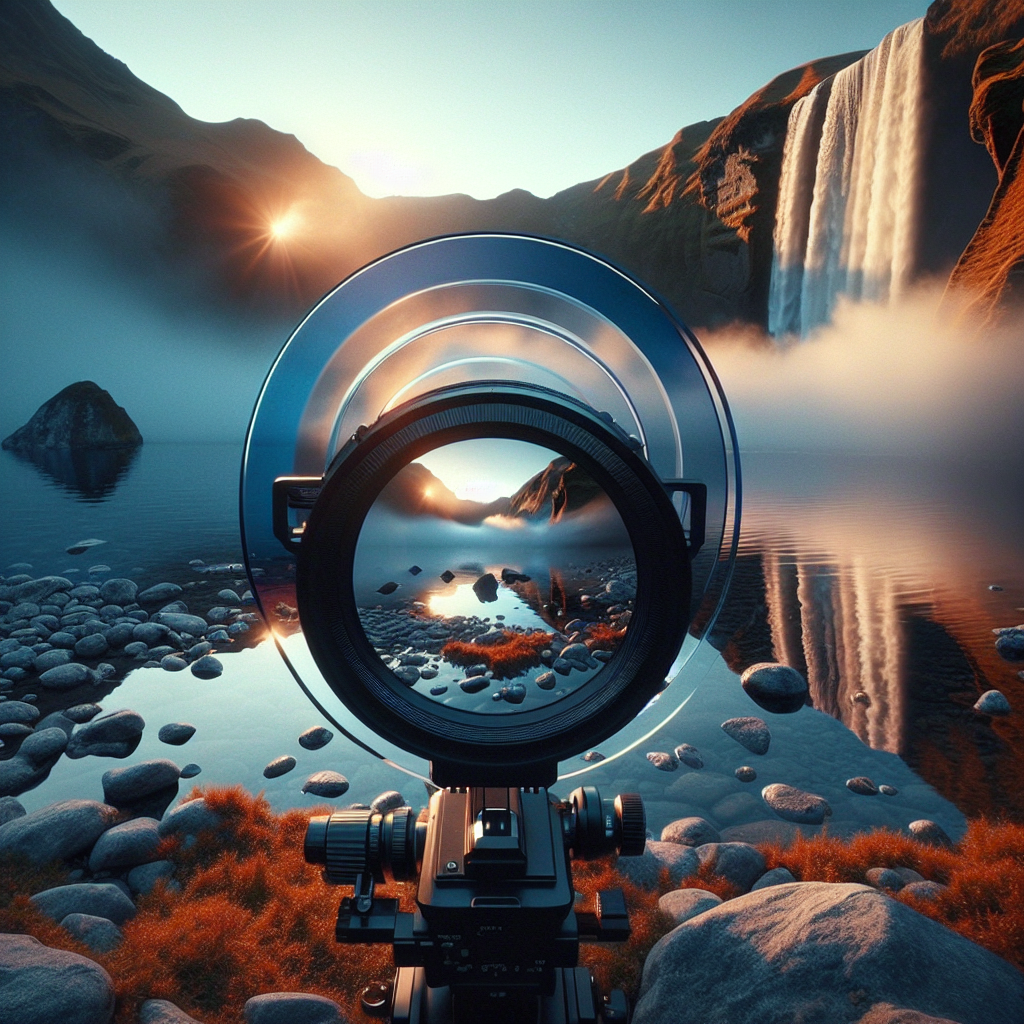
ND Filter vs Polarizer: How to Choose the Right Filter
Many photographers buy their first serious lens filter and discover that nd filter vs polarizer is not an obvious choice. Both are round pieces of glass that screw onto the front of a lens. Both are sold with similar marketing language. Yet they solve very different problems.
Understanding those differences saves money and frustration. It also helps you decide which filter belongs in your bag for landscapes, portraits, video, or travel.
ND Filter vs Polarizer: Core Differences
At a high level, an ND (neutral density) filter reduces the amount of light entering the lens without changing color. A polarizer (often labeled CPL for circular polarizer) controls reflections and glare while also deepening colors and skies.
A quick way to remember the nd vs cpl difference:
-
ND filter: controls exposure time and aperture by cutting light.
-
Polarizer: controls reflections and contrast by filtering polarized light.
Imagine shooting a waterfall at midday. Without a filter, a shutter speed of 1/250 s freezes every droplet. Add a 6‑stop ND filter, and the shutter slows to around 1/4 s at the same aperture and ISO, turning the water into a smooth, silky flow. The scene still looks natural, just with motion blur.
Now imagine photographing a lake at sunset. The water reflects the sky like a mirror, hiding the rocks below the surface. Rotate a circular polarizer, and the surface reflection fades. The rocks appear, colors deepen, and haze in the distance reduces. The shutter speed changes slightly because a polarizer also cuts light, but the main change is in reflections and color.
Both filters affect exposure, but they do it for different reasons and with different visual outcomes.
What an ND Filter Actually Does
An ND filter is essentially sunglasses for your lens. It reduces light evenly across the frame and across the visible spectrum. A good ND filter does not shift color or change contrast; it only changes the exposure settings the camera must use.
Exposure control and motion
The most common use of ND filters is to create motion blur in bright light. Cameras have a limited range of shutter speeds and apertures. On a sunny day at ISO 100, the classic exposure for a static scene at f/8 is around 1/250 s. To blur motion significantly, you might want 1/4 s or 1 second.
A 6‑stop ND filter turns 1/250 s into roughly 1/4 s. A 10‑stop ND turns it into about 4 seconds. That difference is what allows streaking clouds, silky waterfalls, and blurred crowds while buildings stay sharp.
For example, a city street scene at noon might meter at 1/500 s, f/8, ISO 100. With a 10‑stop ND filter, the same exposure requires 2 seconds at f/8. People walking through the frame become ghostly streaks, while the architecture remains crisp.
Aperture control in bright light
ND filters also allow wide apertures in harsh light. Portrait photographers often want f/1.4 or f/2 to blur backgrounds, even at midday. Modern cameras have fast shutters, but many top out at 1/8000 s or 1/4000 s. In strong sun, even 1/8000 s at ISO 100 can be too bright at f/1.4.
Consider a portrait on a beach at noon. The meter reads 1/8000 s at f/4, ISO 100. Opening to f/1.4 is 3 stops more light, so the required shutter becomes 1/64000 s, which most cameras cannot reach. Add a 3‑stop ND filter, and the camera can stay at 1/8000 s while you shoot at f/1.4. The ND filter makes that shallow depth of field possible without overexposure.
Video and the 180‑degree shutter rule
Video shooters rely heavily on ND filters to maintain natural motion. The 180‑degree shutter rule suggests setting shutter speed to roughly double the frame rate. For 25 fps, that is 1/50 s. For 30 fps, 1/60 s. In bright daylight, 1/50 s at f/2.8, ISO 100 will often blow out the highlights.
A variable ND filter solves this by letting you dial in between 2 and 8 stops of light reduction without changing shutter or aperture. For example, filming a walking scene at 24 fps, 1/50 s, f/2.8 on a sunny street becomes practical with a 4–6 stop variable ND. The footage retains natural motion blur instead of the choppy look caused by a very fast shutter.
Fixed vs variable ND
Fixed ND filters provide a specific strength, such as 3, 6, or 10 stops. They are optically simpler and often cleaner, with fewer color shifts and artifacts.
Variable ND filters use two polarizing elements that rotate relative to each other. This design offers flexibility but introduces some side effects:
-
Potential color shifts at higher densities.
-
X‑pattern darkening on wide‑angle lenses at maximum strength.
-
Increased risk of moiré in certain scenes.
For still photography, many prefer fixed ND filters for critical work and variable ND for convenience. For run‑and‑gun video, a good variable ND becomes almost mandatory.
What a Polarizer Actually Does
A circular polarizer (CPL) is not just a dimmer. It selectively removes polarized light, which is the kind of light created by reflections off non‑metallic surfaces such as water, glass, leaves, and haze.
Controlling reflections
The most obvious effect of a polarizer is on reflections. Point the camera at a lake at a 30–40° angle to the surface. Without a polarizer, the water reflects the sky and clouds. Rotate the CPL, and the reflection fades or disappears. The camera now sees into the water, revealing stones, plants, or fish.
The same applies to glass. Photograph a shop window, and you usually capture reflections of the street behind you. With a polarizer rotated correctly, those reflections reduce dramatically. The interior of the shop becomes visible, and colors inside look richer.
On foliage, a polarizer cuts the shiny specular highlights on leaves. The result is deeper greens with more detail and less glare. A forest scene on an overcast day transforms from flat and shiny to rich and textured.
Deepening skies and cutting haze
Polarizers also darken blue skies and increase overall contrast, especially at 90° to the sun. A mid‑day landscape with a pale blue sky and light haze across distant hills can look washed out. Add a polarizer, and the sky deepens, clouds gain definition, and distant hills appear more clearly.
However, the effect is angle dependent. On an ultra wide‑angle lens, the sky may darken unevenly, with a noticeable band of deeper blue in the center. That uneven polarization is a common reason to use the effect gently rather than fully rotating to maximum strength.
Light loss and exposure changes
A polarizer typically reduces light by 1.5–2 stops. That means a shutter speed of 1/250 s without the filter becomes around 1/60 s with it, at the same aperture and ISO. The light loss is a side effect of the polarizing process, not the main purpose of the filter.
In low light, that extra 1.5–2 stops can push the camera toward slower shutter speeds or higher ISO. For indoor or twilight scenes, the benefits of reduced reflections must be weighed against the cost in noise or motion blur.
ND vs CPL: When to Use Each
The core nd filter vs polarizer decision comes down to what you want to control: motion and aperture, or reflections and contrast.
Choose an ND filter when
-
The scene is too bright for the shutter speed and aperture combination you want.
-
You want long exposures to blur water, clouds, traffic, or crowds.
-
You need wide apertures in harsh light for shallow depth of field.
-
You shoot video and must keep shutter speed near double the frame rate.
For example, a seascape at noon with crashing waves often looks chaotic at standard shutter speeds. A 6‑stop ND slows the shutter to 1–2 seconds. The waves become soft streaks, the sky smooths, and the rocks stand out.
Choose a polarizer when
-
Reflections on water or glass hide details you want to reveal.
-
Foliage looks shiny and lacks color depth.
-
The sky is bright and washed out, and you want more contrast.
-
Atmospheric haze reduces clarity in landscapes.
As an example, a mountain lake at sunrise may show a faint reflection of the peaks but also a lot of glare on the water surface. A polarizer reduces that glare, intensifies the colors, and clarifies distant ridges.
Situations where each filter struggles
An ND filter does almost nothing to reflections. If a lake surface is acting as a mirror, an ND filter will simply make the mirror darker. The reflection remains.
A polarizer, on the other hand, cannot extend shutter speeds very far. Two stops of light loss can help slightly, but it will not turn 1/250 s into multi‑second exposures. It also introduces uneven skies on ultra wide‑angle lenses and can make already dark scenes harder to expose.
Understanding these limits helps avoid disappointment. If the goal is to see through water, reach for a polarizer, not a stronger ND. If the goal is 30‑second exposures at midday, a polarizer alone will not get there.
Using ND and Polarizer Together
There are scenes where ND and CPL filters complement each other. Stacking them offers both reflection control and extended shutter speeds, but it must be done carefully.
Landscape example: Waterfall in a forest
Consider a waterfall in a shaded forest. The rocks are wet and shiny, the pool at the base reflects the sky, and the water flow is fast.
-
Without filters: 1/30 s, f/8, ISO 100. The water is partially blurred, but highlights blow out and reflections distract.
-
With a polarizer: 1/10 s, f/8, ISO 100. Reflections on rocks and water reduce, colors deepen, but the water is still not fully silky.
-
With a 6‑stop ND plus polarizer: around 1.3 seconds, f/8, ISO 100. The water becomes smooth, reflections are controlled, and the scene looks calm and rich.
The combined effect can be dramatic. Rocks gain texture, the pool reveals details beneath the surface, and the long exposure adds a sense of motion.
Practical issues when stacking filters
Stacking a CPL and ND filter also introduces complications:
-
Vignetting: On wide‑angle lenses, two stacked filters can cause dark corners, especially on full‑frame cameras at focal lengths below 24 mm.
-
Color casts: Some ND filters already introduce slight color shifts. Adding a polarizer can amplify that, requiring careful white balance or post‑processing corrections.
-
Flare and reflections: More glass surfaces increase the chance of internal reflections, ghosting, and reduced contrast, especially with strong light sources in or near the frame.
To reduce these issues, many photographers use thin‑frame filters, high‑quality multi‑coated glass, and, when possible, square filter systems with a dedicated polarizer integrated into the holder.
Photography Filter Comparison: Practical Scenarios
Looking at photography filter comparison examples helps cement when to choose nd vs cpl.
Long‑exposure cityscapes
Goal: blur traffic and crowds while keeping buildings sharp.
-
Best filter: ND.
-
Reason: the priority is a long shutter speed, not reflection control.
Example: A busy intersection at dusk reads 1/60 s, f/8, ISO 100. Add a 6‑stop ND, and the shutter becomes about 1 second. Car headlights turn into light trails, pedestrians blur, and the city feels alive. A polarizer would only give around 1/15–1/20 s, not enough for strong trail effects.
Coastal landscapes at midday
Goal: soften waves, reduce glare on wet rocks, and deepen sky color.
-
Best filter: ND + CPL together.
-
Reason: ND for shutter speed, polarizer for glare and sky.
Example: A rocky shoreline in strong sun reads 1/500 s, f/11, ISO 100. With a 6‑stop ND and polarizer combined (around 7.5–8 stops), the shutter slows to about 2–4 seconds. The polarizer removes glare from wet rocks and water, while the ND creates misty waves and streaked clouds.
Forest and waterfall scenes
Goal: rich foliage, controlled highlights, and smooth water.
-
Best filter: CPL first, ND second if more blur is needed.
Example: A waterfall in dappled light reads 1/25 s, f/11, ISO 100. A polarizer alone gives about 1/8 s, enough to soften water slightly while deepening foliage. If a more ethereal look is desired, adding a 3‑ or 6‑stop ND extends the shutter to around 1 second or longer.
Portraits outdoors
Goal: shallow depth of field with clean skin tones and manageable reflections in eyes or glasses.
-
Best filter: ND for exposure control; CPL sometimes for reflections.
Example: A portrait at golden hour might meter at 1/2000 s, f/1.4, ISO 100. Many cameras can handle that without ND. At midday, however, the same look might require 1/16000 s, which exceeds the shutter limit. A 3‑stop ND brings the shutter back into range.
A polarizer can help reduce glare on skin or glasses, but the 1.5–2 stops of light loss may push ISO higher or shutter slower than desired. For portraits, ND is usually the first choice, with CPL used selectively.
Architecture and interiors
Goal: see through glass, manage reflections, and keep lines sharp.
-
Best filter: CPL.
Example: Photographing a modern office building with large glass panels, a polarizer lets the camera see inside while reducing reflections from the sky and nearby buildings. In interior shots, a polarizer can help control reflections on polished floors, tabletops, and framed art.
An ND filter offers little benefit here unless a specific long‑exposure effect is desired, such as blurring people in a lobby.
Choosing Your First Filter
For many photographers, budget forces a choice between ND and CPL. The right starting point depends on the kind of images you want most.
If landscapes are the priority
A circular polarizer usually delivers the biggest immediate improvement. It deepens skies, cleans up water and foliage, and cuts haze. Even without long exposures, landscapes gain clarity and color.
Once comfortable with the polarizer, adding a 6‑stop ND opens long‑exposure possibilities. A 3‑stop ND is useful for moderate blur, while a 10‑stop ND is ideal for dramatic multi‑minute exposures at dawn, dusk, or even midday.
If portraits and video dominate
A solid ND or high‑quality variable ND is often more important than a polarizer. Controlling shutter speed and aperture in changing light becomes much easier.
For video, a variable ND covering 2–5 stops works well for most daylight situations. For portraits, a fixed 3‑stop ND often hits the sweet spot between flexibility and image quality.
A polarizer can still help with reflections in glasses or on skin, but it is usually secondary.
If travel and general use matter most
When packing light, a single circular polarizer is a strong all‑rounder. It improves many outdoor scenes, from beaches to cities to mountains. It also doubles as a mild ND, giving roughly 1.5–2 stops of light reduction when needed.
Later, a compact 3‑ or 6‑stop ND can be added for specific long‑exposure shots without significantly increasing weight or bulk.
FAQ: ND Filter vs Polarizer
Is an ND filter the same as a polarizer?
No. An ND filter reduces light uniformly to control shutter speed and aperture. A polarizer reduces reflections and glare, deepens colors, and can darken skies. While a polarizer also cuts some light, its main job is managing polarized light, not just exposure.
Can an ND filter reduce reflections like a CPL?
No. An ND filter does not selectively remove polarized light. It will darken reflections but will not reveal details beneath water or behind glass the way a polarizer can. If the goal is to see through reflections, a CPL is required.
Does a polarizer work as an ND filter?
Only partially. A polarizer typically reduces light by about 1.5–2 stops, which helps a little with exposure control. However, it cannot replace a 6‑ or 10‑stop ND filter when very long exposures are needed for waterfalls, clouds, or traffic trails.
Can you stack an ND filter and a polarizer together?
Yes. Many photographers stack a CPL with an ND filter to combine reflection control with long exposures. The trade‑offs include increased vignetting on wide lenses, higher risk of flare, and potential color casts. Using high‑quality, thin‑frame filters helps minimize these issues.
Which should come first: ND or CPL?
When stacking screw‑in filters, most place the ND filter closest to the lens and the polarizer on the outside. This arrangement allows easier rotation of the CPL without disturbing the ND. In square filter systems, the manufacturer usually defines the correct order, often with the polarizer integrated at the front.
Do ND filters or polarizers affect image sharpness?
Any additional glass can reduce sharpness if poorly made. High‑quality ND and CPL filters with good coatings and flat, polished glass have minimal impact on sharpness. Cheap filters may introduce softness, flare, and color shifts. Investing in one good filter per frequently used lens size is usually better than buying many low‑quality options.
Are variable ND filters just two polarizers?
Yes, variable ND filters use two polarizing elements rotated against each other to vary light transmission. This design provides flexibility but can introduce artifacts such as X‑pattern darkening and color shifts at high densities. For critical stills work, many photographers prefer fixed ND filters.
Do polarizers always improve skies?
No. Polarizers work best on clear days with the camera pointed roughly 90° to the sun. Near sunrise or sunset, or when shooting directly toward or away from the sun, the effect on the sky is weaker. On ultra wide‑angle lenses, the sky can darken unevenly, creating a patchy look.
Choosing between an ND filter and a polarizer starts with a simple question: is the priority to control motion and aperture, or to manage reflections and contrast? Once that is clear, the nd filter vs polarizer decision becomes straightforward, and each filter can be used for what it does best.


Leave a Reply